

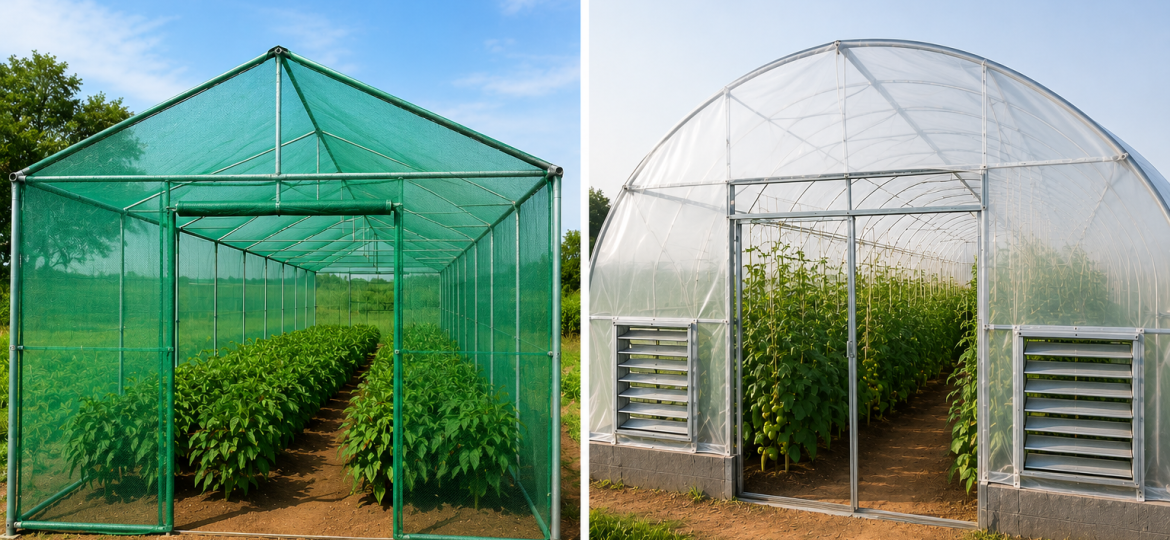
Best Crops for Net House Farming in India With Profit 2026
Building a net house is only one part of successful protected cultivation. The real profitability of a net house depends on selecting the right crop to grow inside it.
Many Indian farmers invest heavily in net house construction with government subsidy support, install quality GI structures, insect nets, and drip irrigation systems, but later struggle financially because of poor crop selection.
Choosing the wrong crop can result in low market prices, weak demand, poor returns, and difficulty recovering the initial investment made in protected cultivation infrastructure.
On the other hand, the right crop can completely transform farm income by generating premium market prices, higher yield, better quality produce, and strong year-round demand from urban markets, retailers, restaurants, and exporters.
Many successful farmers recover their entire net house investment within one to two years by selecting crops that perform exceptionally well under protected cultivation conditions.
In this guide, you will learn about the best and most profitable crops for net house farming in India in 2026, including realistic investment requirements, expected yield, market demand, and profit potential for each crop.
Why Crop Selection is Most Important in Net House Farming
A net house is a major protected cultivation investment for Indian farmers. Even after receiving a 50 percent government subsidy, the farmer’s actual out-of-pocket investment for one acre can still range between ₹14 lakhs and ₹21 per acer lakhs depending on the project structure and financing model.
To recover this investment successfully, the crop grown inside the net house must generate significantly higher income than traditional open-field farming.
The ideal net house crop should command premium market prices that open-field produce cannot easily achieve. It should maintain strong and consistent demand from urban wholesale markets, supermarkets, restaurants, hotels, and export buyers throughout the year.
A profitable protected cultivation crop must also benefit directly from the controlled growing environment of a net house by producing better quality, improved appearance, lower pest damage, and higher yield per acre.
Growing low-value crops such as regular tomato, onion, or chilli inside an expensive net house usually does not provide sufficient returns because these crops are already available in large quantities from open-field farming at relatively low market prices.
In most cases, these common crops face intense market competition and therefore cannot generate the premium pricing needed to justify protected cultivation investment.
The most successful net house farmers focus on crops that are difficult to produce consistently in high quality under normal outdoor conditions. These crops command premium prices precisely because they require the stable and protected environment that a net house provides.
How to Choose the Right Crop for Your Net House
Choosing the right crop for net house farming should never be based only on market price or social media success stories. A crop that performs well for one farmer may not necessarily be profitable for another farmer in a different climate or market.
Before selecting your crop, carefully evaluate these four important factors.
1. Your Location and Climate
Different crops perform better under different climatic conditions. Seedless cucumber and colored capsicum generally grow very well in warm Indian regions, while flowers such as gerbera and chrysanthemum perform better in moderate temperature conditions. Always match your crop selection with your local climate for better yield and lower disease risk.
2. Your Target Market
Before planting any crop, identify who will purchase your produce. Your buyers may include local wholesale vegetable markets, supermarkets, hotels, restaurants, flower shops, retailers, or exporters. A crop without a strong local or regional buyer network can quickly become financially unviable regardless of production quality.
3. Your Investment Capacity
Some crops such as anthurium and gerbera require a higher initial investment in planting material and crop establishment but continue producing for several years without replanting. Other crops such as cucumber and leafy greens require lower starting investment but need seasonal replanting and more frequent crop cycles.
4. Your Farming Experience
Certain crops such as colored capsicum, gerbera, and exotic flowers require more technical farming knowledge and careful crop management. If you are entering protected cultivation for the first time, seedless cucumber is often considered one of the best beginner-friendly net house crops because it is easier to manage and can start generating harvests within approximately 35 to 45 days.
Colored Capsicum — Highest Profit Vegetable Crop
Colored capsicum including red, yellow, and orange varieties is considered one of the most profitable vegetable crops for net house farming in India. It consistently commands premium market prices from supermarkets, hotels, premium retailers, and exporters that open-field farmers usually cannot achieve.
Colored capsicum is highly sensitive to pests such as thrips and mites which can severely reduce crop quality and yield under open-field conditions. An insect-proof net house provides strong physical protection against these pests while also creating a more stable growing environment.
The controlled microclimate inside a net house also helps reduce flower dropping, one of the most common reasons for low yield in open-field capsicum cultivation.
Net house grown colored capsicum usually develops better shape, brighter color, smoother skin, and lower pest damage compared to open-field produce. These quality improvements allow farmers to secure significantly higher market prices.
Most successful farmers use high-quality F1 hybrid seeds from reputed companies such as Syngenta, Nunhems, and East West Seeds for consistent production and premium fruit quality.
| Item | Details |
|---|---|
| Planting to First Harvest | 75 to 90 days |
| Crop Duration | 8 to 10 months |
| Yield Per Acre | 25,000 to 40,000 kg |
| Market Price Per Kg | ₹40 to ₹120 |
| Annual Gross Income | ₹15 Lakhs to ₹25 Lakhs |
| Annual Crop Investment | ₹3 Lakhs to ₹4 Lakhs |
| Annual Net Profit | ₹12 Lakhs to ₹21 Lakhs |
| Investment Recovery Period | Approximately 1 year |
Colored capsicum farming under net house conditions is especially successful in states such as Maharashtra, Karnataka, Himachal Pradesh, Telangana, and Punjab where protected cultivation adoption is already well established.
Farmers can further increase profitability by selling directly to supermarkets, hotels, restaurants, or premium retailers instead of depending entirely on wholesale vegetable markets. Direct marketing often delivers 30 to 40 percent higher prices for high-quality produce.
Cucumber — Best Crop for Beginners
Cucumber is one of the most widely cultivated and commercially successful crops for net house farming in India. It is fast growing, high yielding, relatively easy to manage, and maintains strong year-round demand in vegetable markets, supermarkets, hotels, and restaurants.
Under open-field conditions, cucumber is highly vulnerable to pests such as whiteflies, thrips, and aphids which can severely affect crop quality and production. An insect-proof net house provides effective physical protection against these pests and helps maintain healthier crop growth.
The natural ventilation inside a net house also reduces humidity buildup and helps prevent powdery mildew, one of the most common fungal diseases affecting cucumber cultivation in traditional farming systems.
For first-time protected cultivation farmers, cucumber is often considered the best beginner-friendly crop because of its short growing cycle and relatively simple management requirements.
Most successful farmers prefer seedless Japanese or Dutch hybrid cucumber varieties because they produce better fruit quality, higher yield, and significantly better market prices compared to regular seeded cucumber varieties.
| Item | Details |
|---|---|
| Planting to First Harvest | 35 to 45 days |
| Crop Duration | 4 to 5 months per cycle |
| Cycles Per Year | 2 to 3 |
| Yield Per Acre Per Cycle | 15,000 to 20,000 kg |
| Market Price Per Kg | ₹15 to ₹40 |
| Annual Gross Income | ₹9 Lakhs to ₹15 Lakhs |
| Annual Crop Investment | ₹1.5 Lakhs to ₹2.5 Lakhs |
| Annual Net Profit | ₹7 Lakhs to ₹12 Lakhs |
| Investment Recovery Period | Approximately 1 to 2 years |
Seedless cucumber cultivation under net house conditions is especially successful in states such as Maharashtra, Telangana, Gujarat, Rajasthan, and Andhra Pradesh where warm climate conditions support year-round protected cultivation.
Farmers can significantly increase profitability by growing premium seedless Japanese or Dutch hybrid cucumber varieties because these varieties often command two to three times higher prices than regular cucumber in supermarkets, hotels, and premium urban retail markets.
Gerbera Flowers — Highest Profit Floriculture Crop
Gerbera is one of the most popular cut flowers in India with strong and growing demand from flower shops, wedding decorators, hotels and exporters. It is the highest profit floriculture crop available to net house farmers in India.
Gerbera plants are highly sensitive to pests especially leaf miners, thrips and spider mites. In open field conditions consistent gerbera production is nearly impossible due to pest pressure. Inside a net house gerbera plants produce consistently high quality flowers throughout the year for 3 to 4 years from a single planting.
A 50 percent shade net house provides the ideal light conditions for gerbera. Full direct sunlight causes flower bleaching and reduces vase life. The controlled light inside a shade net house produces vibrant colored flowers with longer vase life that command premium prices in the market.
Which variety to grow: Choose tissue culture gerbera plants from certified nurseries. Popular varieties include Salvadori, Durora, Rosalin and Festival series which give consistent high quality flowers with strong stems and vibrant colors.
| Item | Details |
|---|---|
| First Flower | 3 to 4 months after planting |
| Productive Life | 3 to 4 years per planting |
| Flowers Per Plant Per Year | 35 to 50 stems |
| Plants Per Acre | 20,000 to 25,000 |
| Annual Yield | 7L to 12L stems |
| Market Price Per Stem | ₹3 to ₹8 |
| Annual Gross Income | ₹21L to ₹40L |
| Annual Crop Investment | ₹4L to ₹6L |
| Annual Net Profit | ₹15L to ₹34L |
| Recovery Period | 1 year |
Best states: Maharashtra, Karnataka, Tamil Nadu, West Bengal, Himachal Pradesh
Pro tip: Supply directly to wedding event companies and hotel chains. These buyers pay 50 to 100 percent more than wholesale flower market prices.
Tomato — High Yield Consistent Demand Crop
Tomato is one of the most widely consumed vegetables in India with massive and consistent market demand. Net house tomato farming allows farmers to grow premium quality tomatoes year round with significantly higher yield than open field production.
Tomato is highly susceptible to viral diseases spread by whiteflies. In open field farming whitefly transmitted viruses cause major crop losses across India every season. An insect proof net house eliminates this problem completely by blocking the whitefly vector before it reaches the plants.
Net house tomato plants benefit from the stable growing environment which reduces flower dropping and fruit cracking — two common problems in open field tomato cultivation caused by temperature fluctuation and irregular rainfall.
Which variety to grow: Indeterminate hybrid tomato varieties that produce continuously over a long crop duration give the best results in net house conditions. Varieties like Abhilash, US 440 and Lakshmi are popular among Indian net house farmers.
| Item | Details |
|---|---|
| Planting to First Harvest | 60 to 70 days |
| Crop Duration | 6 to 8 months |
| Yield Per Acre | 40,000 to 60,000 kg |
| Market Price Per Kg | ₹10 to ₹30 |
| Annual Gross Income | ₹8L to ₹15L |
| Annual Crop Investment | ₹1.5L to ₹2.5L |
| Annual Net Profit | ₹6L to ₹12L |
| Recovery Period | 1 to 2 years |
Best states: Maharashtra, Karnataka, Himachal Pradesh, Punjab, Haryana
Pro tip: Grow cherry tomato or cocktail tomato varieties in net houses. These premium varieties sell at ₹60 to ₹120 per kg compared to regular tomato at ₹10 to ₹30 per kg.
Leafy Greens — Fastest Return Crop
Leafy greens including spinach, lettuce, coriander, methi and palak are ideal crops for shade net house farming. They have the shortest growing cycle of any net house crop giving farmers the fastest return on their investment.
Leafy greens are extremely sensitive to excessive heat and direct sunlight. In Indian summers most leafy greens bolt — develop premature flowers that make the leaves bitter and unsaleable — in open field conditions. A 50 percent shade net house maintains a cooler temperature that allows year round production of leafy greens even during peak Indian summer.
The growing urban demand for fresh leafy greens from restaurants, cloud kitchens, juice bars and health conscious consumers in Indian cities creates a strong and consistent market for net house leafy green producers near urban areas.
Which variety to grow: Butter head lettuce and red lettuce varieties command premium prices from restaurants and supermarkets. Baby spinach and microgreens are in very high demand from urban food businesses.
| Item | Details |
|---|---|
| Harvest Time | 25 to 45 days from sowing |
| Cycles Per Year | 6 to 8 |
| Yield Per Acre Per Cycle | 3,000 to 6,000 kg |
| Market Price Per Kg | ₹15 to ₹60 |
| Annual Gross Income | ₹6L to ₹12L |
| Annual Crop Investment | ₹1L to ₹2L |
| Annual Net Profit | ₹5L to ₹10L |
| Recovery Period | 1 to 2 years |
Best states: Karnataka, Maharashtra, Tamil Nadu, Delhi NCR surrounding areas, Gujarat
Pro tip: Supply butter head lettuce and baby spinach directly to restaurants and cloud kitchens in nearby cities. These buyers pay 3 to 4 times wholesale market prices for consistent quality supply.
Herbs — High Value Urban Market Crop
Fresh herbs including basil, mint, coriander, parsley and oregano have rapidly growing demand from restaurants, hotels, cloud kitchens and health food stores in Indian cities. Net house herb farming is one of the most profitable opportunities for farmers located near urban markets.
Herbs are delicate plants that are highly sensitive to pest attack, excessive heat and heavy rain. In open field conditions consistent premium quality herb production is very difficult. Inside a shade net house herbs grow in ideal protected conditions producing consistent quality leaves throughout the year.
The premium pricing of fresh herbs in urban markets — especially for exotic varieties like basil, parsley and oregano — makes herb farming in net houses extremely profitable for farmers with good urban market connections.
Which variety to grow: Sweet basil, Italian basil and Thai basil are in highest demand from restaurants. Flat leaf parsley and curly parsley are popular with hotels. Spearmint and peppermint have strong demand from beverage companies and health food stores.
| Item | Details |
|---|---|
| Harvest Time | 30 to 45 days from transplanting |
| Cycles Per Year | 6 to 8 |
| Yield Per Acre Per Cycle | 2,000 to 4,000 kg |
| Market Price Per Kg | ₹40 to ₹200 |
| Annual Gross Income | ₹8L to ₹20L |
| Annual Crop Investment | ₹1.5L to ₹3L |
| Annual Net Profit | ₹6.5L to ₹17L |
| Recovery Period | 1 year |
Best states: Karnataka, Maharashtra, Tamil Nadu, Delhi NCR surrounding areas, Telangana
Pro tip: Build direct relationships with restaurants and cloud kitchens before planting. A supply contract with even 5 to 10 restaurants guarantees consistent income and eliminates market price risk.
Crop Profit Comparison
| Crop | Annual Profit | Best For | Difficulty |
|---|---|---|---|
| Gerbera | ₹15L – ₹34L | Floriculture farmers | Medium |
| Colored Capsicum | ₹12L – ₹21L | All farmers | Medium |
| Herbs | ₹6.5L – ₹17L | Urban market farmers | Low |
| Cucumber | ₹7L – ₹12L | Beginners | Low |
| Tomato | ₹6L – ₹12L | All farmers | Low |
| Leafy Greens | ₹5L – ₹10L | Urban market farmers | Low |
Frequently Asked Questions
Which is the most profitable crop for net house farming in India?
Gerbera flowers give the highest profit of ₹15 to ₹34 Lakhs per acre per year for farmers with good flower market access. Colored capsicum gives ₹12 to ₹21 Lakhs per acre for vegetable farmers.
Which crop is best for beginner net house farmers?
Cucumber is best for first time net house farmers because of its short 35 to 45 day growing cycle, simple management requirements and strong consistent market demand across all regions of India.
Can I grow multiple crops in one net house?
Yes. Compatible crops like cucumber and leafy greens can be grown together. Growing multiple crops reduces market risk and maintains consistent income throughout the year.
Which net house crop gives fastest return on investment?
Cucumber gives first harvest within 35 to 45 days from transplanting. Leafy greens can be harvested within 25 to 45 days from sowing making them the fastest return crops in net house farming.
Are flower crops more profitable than vegetable crops in net house?
Yes in most cases. Gerbera gives higher income per acre than most vegetable crops. However flower farming requires more technical knowledge and reliable market connections that not all farmers have access to initially.
Which crops are best for net house farming in Rajasthan?
Cucumber and tomato are among the best crops for net house farming in Rajasthan because of the hot and dry climate. These crops tolerate warm conditions well and maintain strong market demand across the state.
Can I export net house crops from India?
Yes. Colored capsicum, gerbera and certain fresh herbs grown in Indian net houses have strong export demand in Middle East, European and Southeast Asian markets. Export prices are often significantly higher than domestic market prices.
Which crop needs least investment to start?
Leafy greens require the lowest initial investment of ₹1 to ₹2 Lakhs per acre per year making them one of the most accessible net house crops for farmers with limited capital.
Conclusion
Your net house is only as profitable as the crop you choose to grow inside it.
For maximum profit potential, crops like gerbera flowers and colored capsicum offer some of the highest returns in Indian protected cultivation farming. For faster cash flow and quicker investment recovery, cucumber and leafy greens are among the best options available.
For first time protected cultivation farmers, cucumber is often the safest starting crop because of its simple management requirements, fast harvest cycle and strong year round market demand. As farming experience and market connections improve, farmers can gradually move towards higher value floriculture or premium vegetable crops.
Before planting any crop, carefully study your local market conditions, identify reliable buyers and understand regional demand patterns. The most profitable crop is not always the crop with the highest market price — it is the crop that best matches your local climate, market access and farming capability.
With the right crop selection and proper management, a net house can become a long term income generating asset that continues producing strong profits for the next 15 to 20 years.
