

What is Net House Farming in India — Complete Guide 2026
Every morning millions of Indian farmers walk to their fields with one silent fear — what did the insects destroy last night. Pests, whiteflies, thrips, aphids — these tiny creatures cause massive crop losses across India every single season. Add to that the unpredictable rain, scorching summer heat and strong winds and you have a situation where the farmer works hard but nature decides the result. This is the reality of open field farming in India. But today a growing number of Indian farmers have found a simple and powerful solution to this problem. They are building net houses on their farms and the results are remarkable.
In this complete guide you will learn everything about what a net house is, how it works, what types exist in India and why it is changing the future of Indian agriculture in 2026.
What is a Net House
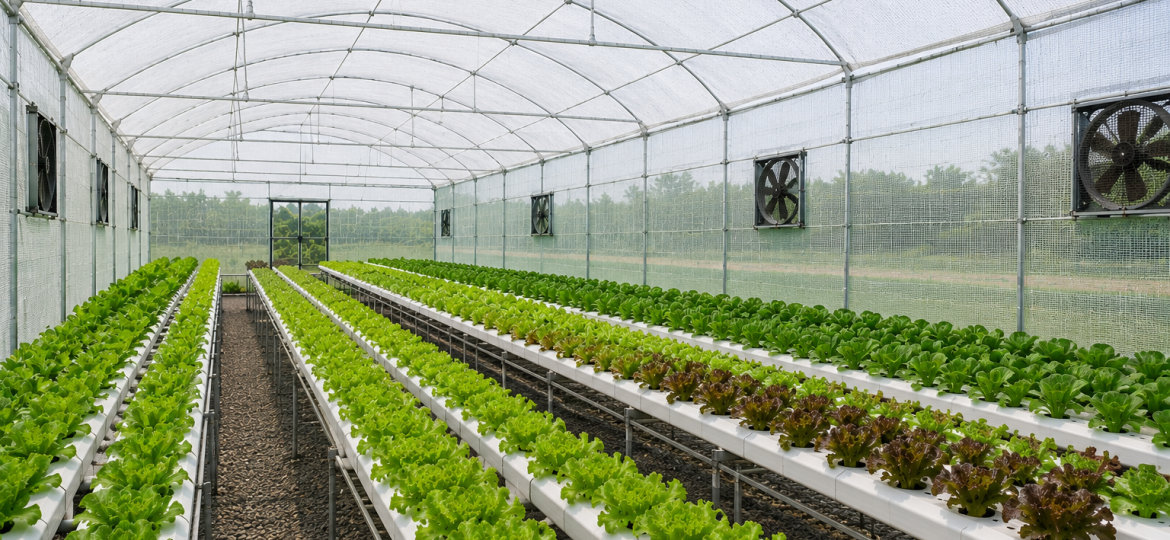
A net house is a farming structure built using galvanized iron pipes covered with fine mesh nets on all sides including the roof. Imagine a large protective cage built over your crops. The mesh net has thousands of tiny holes that are big enough for air, sunlight and moisture to pass through freely but small enough to stop insects, pests and birds from entering. The GI pipe frame gives the structure its strength and shape. It is rust resistant and built to last for 20 to 25 years with regular care. A net house can be built in any size. Small farmers build structures as small as 500 square meters. Large commercial farmers build structures of 5000 square meters or more. The net house creates a safe and stable environment where your crops grow without the constant threat of insects, pests and harsh weather.
What is Net House Farming
Net house farming is simply the practice of growing crops inside a net house instead of in open fields.In open field farming your crops face every threat nature throws at them. Insects land on your plants freely. Pests multiply without barriers. Storms damage your crop overnight. As a farmer you have very little control over what happens to your cropsNet house farming changes this completely.Inside a net house you are in control. Insects and pests are blocked physically by the mesh net. Excessive sunlight is filtered. Strong winds are slowed down before they reach your crops. Heavy rain does not fall directly on your plants.
The result is a stable protected environment where your crops grow consistently and reach their full potential.
Net house farming is one type of protected cultivation. Protected cultivation includes polyhouses and greenhouses as well. Among all three options net house farming is the most affordable and most suitable for the warm climate conditions found across most of India.
History of Net House Farming in India
Protected cultivation started gaining importance in India during the 1990s when the central government began actively promoting modern farming practices to boost agricultural productivity. In the early years polyhouses and greenhouses received most of the attention. However these structures required large investments that were beyond the reach of most Indian farmers.
Net houses emerged as a practical and affordable alternative. The lower construction cost and simpler technology made net houses accessible to small and marginal farmers across the country.Over the past two decades government schemes like the National Horticulture Board and Mission for Integrated Development of Horticulture have played a major role in promoting net house farming by offering financial subsidies and technical training to farmers.
Today thousands of net houses operate successfully across Maharashtra, Telangana, Karnataka, Rajasthan, Gujarat and Himachal Pradesh. The number of farmers adopting net house farming grows every year as more people see the results their neighbors are achieving.
How Does a Net House Work
A net house works on one simple but powerful principle — physical protection through a mesh barrier. It creates a controlled growing environment where crops remain protected while still receiving natural air and sunlight.
Air Flow
The holes in the mesh net allow natural air to move freely inside the structure. This keeps the internal temperature moderate and prevents excessive heat buildup. Unlike polyhouses that trap heat, net houses remain naturally ventilated and are highly suitable for warm Indian climates.
Sunlight Control
Natural sunlight passes through the mesh and reaches the crops efficiently. In insect-proof net houses, maximum sunlight enters the structure, while shade net houses filter a percentage of sunlight to protect sensitive crops from harsh heat and direct exposure.
Pest and Insect Protection
One of the most important functions of a net house is preventing insect attacks. Fine mesh nets such as 40 or 50 mesh contain extremely small holes that block insects like thrips, whiteflies, and aphids from entering the cultivation area. This greatly reduces pesticide usage and crop damage.
Rain Protection
The roof structure of the net house prevents heavy rainfall from directly damaging the crops. This helps reduce waterlogging, fungal infections, and physical plant damage while maintaining balanced humidity levels inside the structure.
Wind Protection
Strong winds can damage crops, break stems, and spread diseases quickly. The mesh walls of the net house reduce wind pressure before it reaches the plants, creating a safer and more stable growing environment.
Types of Net House in India
There are several types of net houses used by Indian farmers based on crop requirements, climate conditions, and investment capacity. Each type offers different benefits for cultivation and crop protection.
1. Insect Proof Net House
This is the most widely used net house type in India. It uses fine mesh nets such as 40 mesh or 50 mesh that prevent even tiny insects from entering the cultivation area. It is highly suitable for crops like cucumber, capsicum, tomato, brinjal, and beans where pest attacks can severely impact production and quality. Farmers using insect-proof net houses often experience lower pesticide usage and better crop quality.
2. Shade Net House
Shade net houses use specially designed shade nets that filter sunlight entering the structure. These nets are available in different shading percentages such as 35%, 50%, and 75%. This type is ideal for crops that cannot tolerate intense sunlight and high temperatures, including leafy vegetables, nursery plants, herbs, and flowers. Shade net houses are especially popular in hot regions like Rajasthan, Gujarat, and Telangana.
3. Wire Rope Net House
A wire rope net house uses stretched wire ropes for support instead of a heavy GI pipe framework. This design significantly reduces construction costs and makes the structure affordable for small and marginal farmers. It is commonly used for vegetable and flower cultivation in states like Maharashtra and Karnataka.
4. Dome Shaped Net House
Dome shaped net houses feature a curved roof structure that allows rainwater to flow away efficiently and reduces the risk of water accumulation on top. The aerodynamic design also helps the structure withstand stronger winds. Due to their durability and low maintenance requirements, dome shaped net houses are considered one of the strongest options available.
5. Flat Roof Net House
The flat roof net house is one of the most commonly constructed designs in India. Its simple structure makes it cost effective and easy to build. This type is suitable for areas with moderate rainfall and wind conditions and is widely used for growing vegetables, flowers, and other high-value crops across the country.
Materials Used in Net House Construction
Understanding the main components of a net house helps farmers evaluate its durability, performance, and long-term value. Each part of the structure plays an important role in protecting crops and maintaining a controlled growing environment.
GI Pipes and Structural Frame
Galvanized iron pipes form the primary framework of the net house. These pipes are available in different thickness grades, with thicker pipes offering greater strength and durability. A properly installed GI frame with regular anti-rust treatment can easily last 20 to 25 years with minimal maintenance.
UV Stabilized Net Material
The covering net is made from UV stabilized high-density polyethylene material that resists damage from prolonged sunlight exposure. Net houses commonly use 40 mesh or 50 mesh nets. A finer 50 mesh net offers better insect protection, while a 40 mesh net provides slightly better airflow inside the structure.
Aluminum Locking Profiles
Aluminum locking profiles are used to secure the net tightly onto the GI pipe structure. These profiles help keep the net fixed firmly in place and prevent gaps from forming, even during strong winds and adverse weather conditions.
Concrete Foundation
The vertical support pipes are embedded into concrete foundations to provide stability and structural strength. A strong concrete base allows the net house to withstand heavy rain, wind pressure, and long-term environmental stress without damage.
Double Door Entry System
Most modern net houses include a double-door entry system for better insect control. Farmers close the outer door before opening the inner door, reducing the chances of pests entering the protected cultivation area.
Drip Irrigation System
A drip irrigation system is commonly installed inside the net house to deliver water directly to plant roots. This system improves water efficiency, reduces disease risk caused by excess moisture, and ensures uniform irrigation for healthier crop growth.
Net House Farming vs Open Field Farming
| Feature | Net House Farming | Open Field Farming |
|---|---|---|
| Pest Protection | Excellent | None |
| Crop Yield | 30 to 50 percent higher | Standard |
| Water Usage | 40 percent less | High |
| Pesticide Use | 70 percent less | High |
| Year Round Farming | Yes | Seasonal only |
| Crop Quality | Premium | Standard |
| Weather Protection | Yes | No |
| Initial Investment | Medium | Low |
| Long Term Profit | High | Medium |
Net House Farming Across Different States of India
Net house farming is practiced across India, but certain states have emerged as major centers for protected cultivation due to government support, climate conditions, and increasing demand for high-quality crops.
– Maharashtra
Maharashtra is one of the leading states in net house farming adoption. Farmers in regions like Pune, Nashik, Satara, and Kolhapur cultivate vegetables and flowers inside net houses for both domestic and export markets. Government subsidy schemes and agricultural training programs have played a major role in encouraging farmers to adopt protected cultivation techniques.
– Rajasthan
In Rajasthan, net house farming helps farmers manage extreme summer temperatures and severe water scarcity. Farmers in Jaipur, Jodhpur, Kota, and Bikaner successfully grow high-value crops inside protected structures despite challenging climatic conditions.
– Telangana and Andhra Pradesh
Telangana and Andhra Pradesh offer some of the highest government subsidies for net house construction in India. This financial support has accelerated the adoption of protected farming across both states. Many farmers have reported significant improvements in crop quality, productivity, and overall farm income after shifting to net house cultivation.
– Karnataka
Farmers in areas surrounding Bengaluru, Belagavi, and Dharwad widely use net houses to grow leafy vegetables, flowers, and premium crops. The strong demand from Bengaluru’s urban markets makes protected farming highly profitable for Karnataka farmers.
– Himachal Pradesh
In Himachal Pradesh, net houses provide protection against hailstorms, heavy monsoon rainfall, and insect attacks during the short growing season. Farmers in Shimla, Kullu, and Mandi cultivate premium vegetables and flowers that are sold at high prices across northern Indian markets.
– Gujarat
Farmers in Saurashtra and North Gujarat use net houses along with drip irrigation systems to overcome extreme heat and water shortages. This combination has significantly improved agricultural productivity and crop quality in many parts of the state.
Who Should Start Net House Farming in India
Net house farming is suitable for a wide range of farmers and agricultural entrepreneurs. Its lower investment requirement, government support, and ability to improve crop quality make it an attractive option for both beginners and experienced growers.
Small and Marginal Farmers
Farmers with even a small landholding of around 0.5 acres can successfully start net house farming. Government subsidy schemes often cover up to 50 percent of the construction cost, making the investment more affordable for farmers with limited capital.
Vegetable Growers
Farmers currently growing vegetables in open fields can benefit greatly from switching to net house cultivation. Protected structures reduce insect attacks, improve crop quality, and help farmers achieve better market prices for vegetables such as tomato, capsicum, cucumber, and beans.
Flower Growers
Net houses are highly suitable for floriculture farming. Premium flowers such as gerbera, anthurium, and chrysanthemum can be cultivated successfully under protected conditions. These flowers are in strong demand across domestic and export markets and often generate higher profits compared to traditional field cultivation.
Young Farmers and Agri Entrepreneurs
Young farmers, agri startups, and entrepreneurs entering the agriculture sector can use net house farming as a modern and profitable business model. With increasing demand for high-quality produce and strong government support, protected cultivation offers significant long-term growth potential.
First Time Protected Cultivation Farmers
Farmers who want to begin protected cultivation but find polyhouses and greenhouses too expensive often choose net house farming as an affordable and practical starting point. It provides many of the benefits of protected farming at a comparatively lower cost.
Net House Farming — The Future of Indian Agriculture
Indian agriculture is facing major long-term challenges including climate change, rising temperatures, water scarcity, increasing input costs, and growing demand for safer food. Traditional open-field farming is becoming more difficult and unpredictable for many farmers across the country.
– Protection Against Climate Change
Net house farming helps protect crops from unpredictable weather conditions such as excessive heat, strong winds, heavy rainfall, and pest outbreaks. This controlled growing environment improves crop survival and provides greater stability in agricultural production.
– Better Water and Input Efficiency
Net houses are commonly combined with drip irrigation systems that reduce water usage significantly. Farmers also save money on pesticides and chemicals because the protective mesh prevents many insects and pests from reaching the crops.
– Growing Demand for Premium Produce
Urban consumers are increasingly looking for cleaner, safer, and higher-quality fruits, vegetables, and flowers. Net house farming allows farmers to produce premium-quality crops that often receive better prices in local and export markets.
– Government Support for Protected Cultivation
Government schemes such as the National Horticulture Board (NHB) and Mission for Integrated Development of Horticulture (MIDH) continue to promote protected cultivation through subsidies, technical support, and farmer training programs. These initiatives are making net house farming more accessible to farmers across India.
– The Road Ahead
As climate challenges increase and modern farming techniques become more important, net house farming is expected to grow rapidly across India. By 2030, protected cultivation methods like net house farming are likely to become one of the most widely adopted agricultural practices among progressive Indian farm
Frequently Asked Questions
What is the meaning of net house farming?
Net house farming means growing crops inside a protective structure made of fine mesh nets fixed on a GI pipe frame. The mesh blocks insects and pests while still allowing natural air, sunlight, and moisture to reach the crops.
Is net house farming suitable for small farmers in India?
Yes. With government subsidies covering up to 50 percent of the construction cost, even small farmers with limited land can start net house farming profitably.
What is the difference between net house farming and open field farming?
Open field farming leaves crops exposed to pests, weather, and temperature changes, while net house farming protects crops and improves both yield and crop quality.
Is net house and shade net house the same thing?
A net house mainly uses insect-proof mesh for pest protection, while a shade net house is designed to reduce sunlight and heat exposure for sensitive crops.
How long does a net house last in India?
A properly constructed GI pipe net house can last 15 to 20 years, while the net covering usually needs replacement every 5 to 7 years.
Which states in India are best for net house farming?
Maharashtra, Telangana, Karnataka, Rajasthan, Gujarat, and Himachal Pradesh are among the leading states for net house farming in India.
Is net house farming the same as protected cultivation?
Net house farming is one type of protected cultivation. Polyhouses and greenhouses are also protected cultivation methods used in modern agriculture.
What crops can be grown in a net house?
Vegetables, flowers, leafy greens, herbs, and several high-value crops can be successfully cultivated inside a net house.
Conclusion
Net house farming is more than just a modern agricultural method. It is a practical and affordable solution for many of the biggest challenges faced by Indian farmers today. From unpredictable weather conditions to rising input costs and pest attacks, net house farming provides a reliable way to protect crops and improve farm productivity.
By creating a controlled growing environment, net houses help farmers reduce water usage, lower pesticide dependency, and produce higher quality crops throughout the year. The result is better crop protection, improved yields, and stronger income opportunities for farming families.
With continued government support through subsidy schemes and protected cultivation programs, this is one of the best times for Indian farmers to invest in net house farming. Whether you own 0.5 acres or manage large-scale farmland, protected cultivation can help transform your agricultural business in the coming years.
Start by speaking with your nearest horticulture department or agriculture officer to learn about available subsidies and construction support. A well-planned net house can provide better crop protection, higher profitability, and a more secure future for your family and farm.
