

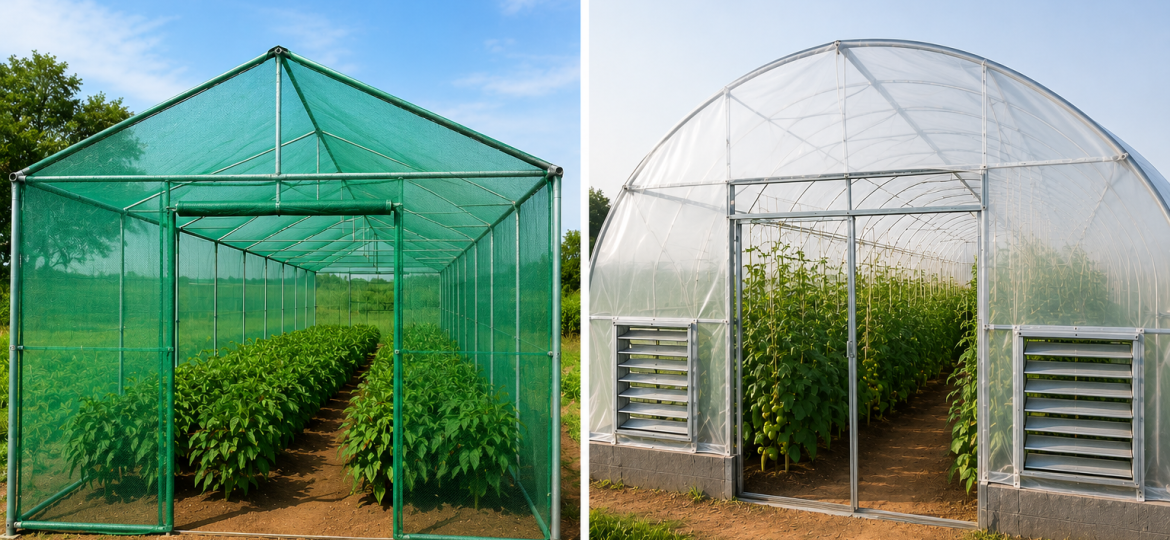
Net House vs Polyhouse — Which is Better for Indian Farmers 2026
Net house and polyhouse farming are two of the most popular forms of protected cultivation in India. Both systems help farmers improve crop quality, increase yield, reduce weather damage, and earn better profits compared to traditional open-field farming. In many Indian states, both structures also qualify for government subsidy schemes under protected cultivation programs.
Although both systems are used for modern farming, a net house and a polyhouse are designed for very different farming conditions, crop requirements, climates, and investment levels. The right choice depends on factors such as your farming budget, local temperature conditions, target crops, and long-term business goals.
A net house mainly focuses on protecting crops from insects, pests, excessive wind, and moderate weather stress while maintaining natural airflow inside the structure. A polyhouse, on the other hand, creates a more controlled growing environment by covering the structure with plastic film that traps heat and humidity inside.
Because of these structural differences, the cost, maintenance requirements, crop suitability, temperature control, and profit potential can vary significantly between the two systems.
In this complete guide, you will understand the major differences between net house and polyhouse farming in India, including construction cost, government subsidies, ideal crops, climate suitability, advantages, disadvantages, and which option may be better for your farm in 2026 and beyond.
What is a Net House
A net house is a protected farming structure built using a galvanized iron pipe frame covered with fine mesh nets on all sides, including the roof.
The mesh net allows natural sunlight, fresh air, and moisture to pass through freely while physically preventing insects, pests, birds, and other external threats from reaching the crops grown inside the structure.
Unlike a polyhouse, a net house does not trap heat inside the structure. Continuous natural airflow helps maintain a moderate internal temperature, making net houses highly suitable for warm and tropical regions across India.
Net houses are commonly used for growing vegetables, flowers, herbs, nursery plants, and leafy greens where insect protection, better crop quality, and partial climate control are the primary farming requirements.
What is a Polyhouse
A polyhouse is a protected farming structure constructed using a galvanized iron or tubular steel frame covered with UV-stabilized polyethylene film instead of mesh netting.
The plastic film covering creates a greenhouse effect inside the structure by trapping heat and maintaining controlled humidity levels. This creates a far more controlled growing environment compared to a standard net house.
Unlike a net house, a polyhouse does not allow unrestricted natural airflow. Ventilation inside the structure is controlled through roof vents, side vents, cooling systems, and sometimes exhaust fans depending on the design and technology level of the polyhouse.
Because of this controlled environment, farmers can regulate temperature, humidity, and moisture levels much more precisely than in open farming or net house cultivation.
Polyhouses are mainly used for cultivating high-value crops that require stable environmental conditions, including exotic vegetables, premium flowers, nursery plants, and off-season crops that cannot be grown successfully under normal outdoor climate conditions.
Net House vs Polyhouse — Key Differences
| Feature | Net House | Polyhouse |
|---|---|---|
| Covering Material | Mesh net | Polyethylene film |
| Air Circulation | Natural and free | Controlled through vents |
| Temperature Control | Partial | Good to excellent |
| Humidity Control | Low | High |
| Heat Trapping | No | Yes |
| Insect Protection | Excellent | Good |
| Suitable Climate | Warm and hot regions | Cool and moderate regions |
| Construction Cost | Lower | Higher |
| Operating Cost | Low | Medium to high |
| Government Subsidy | Available | Available |
| Lifespan | 15 to 20 years | 10 to 15 years |
Climate Suitability Comparison
Climate suitability is one of the most important factors when choosing between a net house and a polyhouse. Selecting the wrong structure for your local climate can lead to poor crop performance, excessive maintenance costs, and even complete crop failure regardless of investment size.
– Net House — Best for Warm and Hot Regions
A net house allows continuous natural airflow through the mesh structure and does not trap heat inside. This makes it highly suitable for Indian states where summer temperatures are already very high and crops need protection without additional heat buildup.
Net houses are generally considered the best choice for states such as Rajasthan, Gujarat, Maharashtra, Telangana, Andhra Pradesh, Karnataka, Tamil Nadu, and other warm or tropical regions of India.
In these regions, a polyhouse without expensive cooling systems can become excessively hot during summer months, creating severe heat stress that may damage crops and reduce productivity. A net house provides crop protection while maintaining better ventilation and moderate temperatures.
– Polyhouse — Best for Cool and Moderate Regions
A polyhouse traps heat and humidity inside the structure, creating a warmer and more controlled growing environment. While this can become a disadvantage in very hot climates, it offers major benefits in cooler regions where crops require additional warmth for healthy growth.
Polyhouses are generally more suitable for states such as Himachal Pradesh, Uttarakhand, Jammu and Kashmir, Punjab, Haryana, and other regions with cool or moderate climatic conditions.
In these areas, a polyhouse helps extend the growing season by maintaining warmer internal temperatures during winter and cold months when open-field farming becomes difficult or impossible for many high-value crops.
What Happens When You Choose Wrong
Choosing the wrong protected cultivation structure for your climate can completely destroy crop productivity and turn a profitable farming investment into a financial loss.
For example, a farmer in Rajasthan who builds a polyhouse without an advanced cooling system may face internal temperatures reaching 55 to 60 degrees Celsius during peak summer months. At these temperatures, most crops experience severe heat stress, wilting, flower drop, and eventual crop failure.
On the other hand, a farmer in Himachal Pradesh who builds only a net house may struggle during winter because a net house provides very limited protection against cold temperatures, frost, and freezing conditions.
In colder regions, crops inside a simple net house may stop growing or become damaged during winter months due to insufficient temperature protection.
The most important rule in protected cultivation is simple — always match the farming structure to your local climate conditions. This single decision has a greater impact on long-term farming success than almost any other factor.
Crop Suitability Comparison
Different crops perform better in different protected cultivation systems. The right structure depends on the crop’s temperature requirements, humidity tolerance, airflow needs, and sensitivity to pests and diseases.
– Best Crops for Net House Farming
Seedless cucumber is one of the most successful crops for net house farming across India. Natural ventilation combined with strong insect protection creates ideal growing conditions for high-quality cucumber production throughout the year.
Colored capsicum including red, yellow, and orange varieties performs exceptionally well inside net houses in warm Indian states where proper airflow helps reduce fungal disease pressure.
Leafy greens such as spinach, lettuce, coriander, and methi grow successfully in shade net house systems where reduced sunlight intensity improves leaf quality and reduces heat stress.
Gerbera, chrysanthemum, anthurium, and other tropical flowers are highly profitable crops commonly cultivated inside net houses due to improved flower quality and longer vase life.
Herbs including basil, mint, and coriander also grow very well in net house conditions and maintain strong demand from restaurants, hotels, and urban food businesses.
– Best Crops for Polyhouse Farming
Tomato is one of the most widely grown polyhouse crops in India, especially in cooler states where the controlled environment allows year-round production and higher yields.
Bell peppers including green, red, and yellow varieties perform extremely well in polyhouses because precise temperature and humidity control improves fruit quality and productivity.
Premium floriculture crops such as roses and carnations are primarily grown in polyhouses because they require stable environmental conditions and accurate climate control throughout the growing cycle.
Exotic vegetables including broccoli, baby corn, colored cabbage, and specialty herbs are also highly suitable for polyhouse cultivation in cooler Indian regions.
Strawberry cultivation under polyhouse systems has become especially profitable in hill states such as Himachal Pradesh and Uttarakhand where temperature management significantly improves fruit quality and yield.
| Crop | Net House | Polyhouse |
|---|---|---|
| Seedless Cucumber | Excellent | Good |
| Colored Capsicum | Excellent | Excellent |
| Tomato | Good | Excellent |
| Gerbera Flower | Excellent | Good |
| Rose Flower | Not Suitable | Excellent |
| Leafy Greens | Excellent | Good |
| Strawberry | Not Suitable | Excellent |
| Anthurium | Excellent | Good |
| Herbs | Excellent | Good |
Operating Cost Comparison
Beyond the initial construction investment, the long-term operating cost of running a net house and a polyhouse is significantly different. Understanding these ongoing expenses is important before selecting the right protected cultivation system for your farm.
– Net House Operating Costs
Electricity consumption inside a net house is usually minimal because the structure relies on natural airflow instead of powered cooling systems. In most cases, no fans, exhaust systems, or heaters are required.
Maintenance costs are also relatively low. Farmers mainly need to inspect the insect net regularly for holes or damage and repair them immediately to maintain pest protection. The GI frame generally requires anti-rust treatment every few years for long-term durability.
The largest periodic maintenance expense in a net house is net replacement. UV-stabilized insect nets usually last around 5 to 8 years depending on climate conditions and material quality.
Drip irrigation systems inside net houses are highly water efficient and typically reduce water consumption by 30 to 40 percent compared to traditional open-field farming.
– Polyhouse Operating Costs
Polyhouses generally have significantly higher operating expenses because they require climate management systems such as cooling fans, exhaust systems, and pad cooling units, especially in warmer regions.
Electricity costs can become substantial during summer months due to continuous operation of ventilation and cooling equipment.
Polyethylene film replacement is another major recurring expense. Depending on film quality and weather exposure, the plastic covering generally requires replacement every 3 to 5 years.
Polyhouses also require ongoing maintenance of ventilation motors, cooling pads, humidity control systems, and environmental monitoring equipment.
| Cost Item | Net House | Polyhouse |
|---|---|---|
| Electricity | ₹5,000 – ₹15,000 | ₹60,000 – ₹2,00,000 |
| Maintenance | ₹20,000 – ₹40,000 | ₹40,000 – ₹80,000 |
| Material Replacement (Annual) | ₹40,000 – ₹80,000 | ₹50,000 – ₹1,00,000 |
| Total Annual Operating Cost | ₹65,000 – ₹1,35,000 | ₹1,50,000 – ₹3,80,000 |
Overall, the annual operating cost of a net house is generally 50 to 60 percent lower than a polyhouse of the same size. This lower running cost makes net houses especially attractive for farmers in warm regions who want protected cultivation with lower long-term expenses.
Frequently Asked Questions
Which is better — net house or polyhouse for Indian farmers?
The better option depends on your climate, crop selection, and budget. Net houses are generally better for warm and hot Indian regions, while polyhouses are more suitable for cooler climates. For first-time protected cultivation farmers, net houses are usually more affordable and easier to manage.
What is the cost difference between a net house and a polyhouse?
A standard net house generally costs around ₹600 to ₹800 per square meter, while a basic polyhouse usually costs between ₹900 and ₹1200 per square meter. In most cases, a net house is approximately 30 to 40 percent cheaper than a polyhouse of similar size.
Do both structures receive government subsidy?
Yes. Both net houses and polyhouses are eligible for government subsidies under schemes such as NHB and MIDH. Several Indian states also provide additional financial assistance for protected cultivation projects.
Which structure lasts longer?
A properly built GI pipe net house generally lasts around 15 to 20 years, while most polyhouses have a lifespan of approximately 10 to 15 years. Net houses usually last longer because insect mesh material is more durable than polyethylene film.
Which structure is easier for beginners to manage?
A net house is generally much easier for new farmers to manage because it does not require complex climate control systems. Farmers with basic agricultural knowledge can usually operate a net house successfully with proper crop planning.
Can the same crops be grown in both structures?
Many crops such as capsicum, cucumber, and leafy greens can be cultivated in both systems. However, some crops perform significantly better in one structure over the other. Roses generally require a polyhouse, while gerbera flowers often perform better inside a net house.
Which structure generates higher income per acre?
A well-managed polyhouse can generate higher gross income per acre due to advanced climate control and off-season production capability. However, because polyhouses also have higher construction and operating costs, the net profit margin may sometimes be similar to or even lower than a successful net house operation.
Is net house farming suitable for beginners?
Yes. Net house farming is considered one of the best entry points into protected cultivation for Indian farmers. It is more affordable, simpler to operate, and highly effective for growing vegetables, flowers, herbs, and leafy greens.
Conclusion
Both net house and polyhouse farming are powerful protected cultivation systems that can significantly improve crop quality, increase yield, reduce weather-related losses, and generate better long-term income compared to traditional open-field farming.
The right choice is not about selecting the structure that is universally better. The correct decision depends entirely on your local climate conditions, crop selection, farming experience, and investment capacity.
Farmers in warm and hot Indian states who want an affordable and easy-to-manage protected cultivation system for vegetables, flowers, herbs, and leafy greens will generally benefit more from a net house.
Farmers in cooler regions who want precise temperature and humidity control for high-value or temperature-sensitive crops throughout the year may find a polyhouse to be the better long-term investment.
When the structure is matched correctly with the local climate and crop type, both systems can transform farm productivity and income potential for the next 15 to 20 years.
Farmers planning to start protected cultivation should contact their nearest district horticulture department to explore available subsidy schemes, compare project costs carefully, and select the structure that best fits their farming goals in 2026 and beyond.
