

Scroll Top
Net House Farming in India: Cost per Acre, Crops, Profit & Subsidy
Net House Farming Solutions for High-Profit Commercial Agriculture

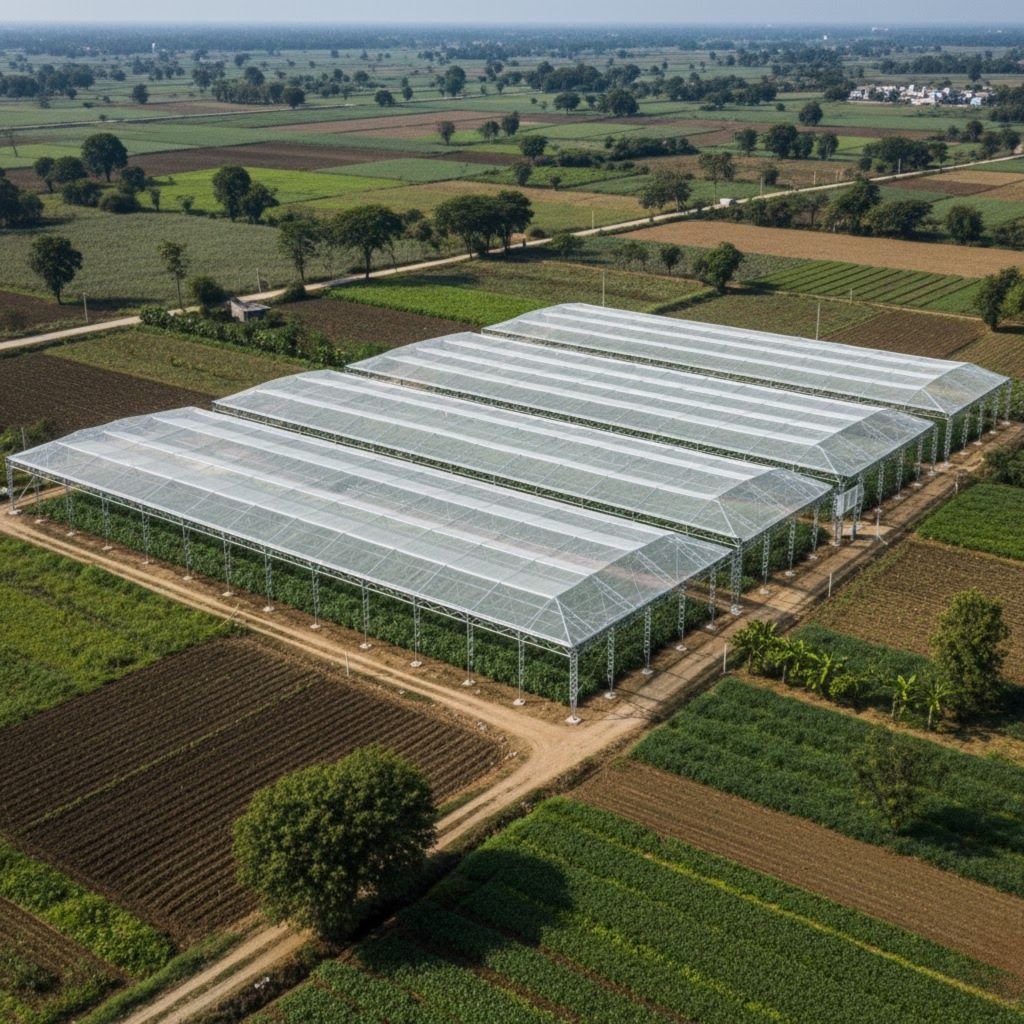
We provide professional net house installation solutions for high-profit protected cultivation in India, helping farmers and agribusinesses achieve higher yield, better crop quality, and consistent income. Our turnkey services cover complete project planning, structural design, material supply, and on-site installation, ensuring long-term durability and compliance with subsidy norms.

Each net house installation is customized based on crop type, land size, wind zone, and local climatic conditions to deliver reliable year-round performance. We use high-strength GI structures, UV-stabilized shade nets, and proven engineering practices to build robust net houses with timely execution and dependable post-installation support. MAKE IR IN 3 LINES
Crop & Climate Based Design 80%
80%
Durable Shade Net & Structure 86%
86%
Installation & After-Support 88%
88%

By focusing on practical execution and field-tested engineering, we help farmers reduce operational challenges while maximizing yield and crop quality across seasons. Each net house installation is planned to maintain a stable microclimate, improve plant health, and ensure predictable production cycles. With optimized structure design and durable materials, our solutions minimize maintenance requirements, lower long-term operating costs, and support scalable, high-profit protected farming for vegetables, flowers, and nursery crops.

Types of Net House Structures Used in India

Net house structures in India are designed based on regional climate, wind conditions, rainfall pattern, and crop requirements. Choosing the right type of net house structure is critical for long-term durability, crop performance, and return on investment. The most commonly used net house structures in India are Flat Roof, Dome Shape, and Rain-Protected ‘A’ Roof designs.

Need a Net House for Your Farm?

Flat roof net house structures are a cost-effective and widely used solution for protected cultivation in India. Designed with a strong GI framework and flat shade-net roofing, they provide reliable crop protection, good airflow, and uniform light distribution. Flat roof net houses are ideal for low-wind regions and are commonly used for vegetables, nursery plants, and commercial farming projects due to their lower investment and faster installation.

Key Benefits of Flat Roof Net House:

  • Cost-effective solution for protected cultivation with lower investment
  • Faster installation and quicker project execution
  • Suitable for vegetables, nursery plants, and short-cycle crops
  • Ensures good airflow and uniform light distribution
  • Eligible for NHB and NHM subsidy schemes
  • Easy to maintain with low operational and maintenance cost
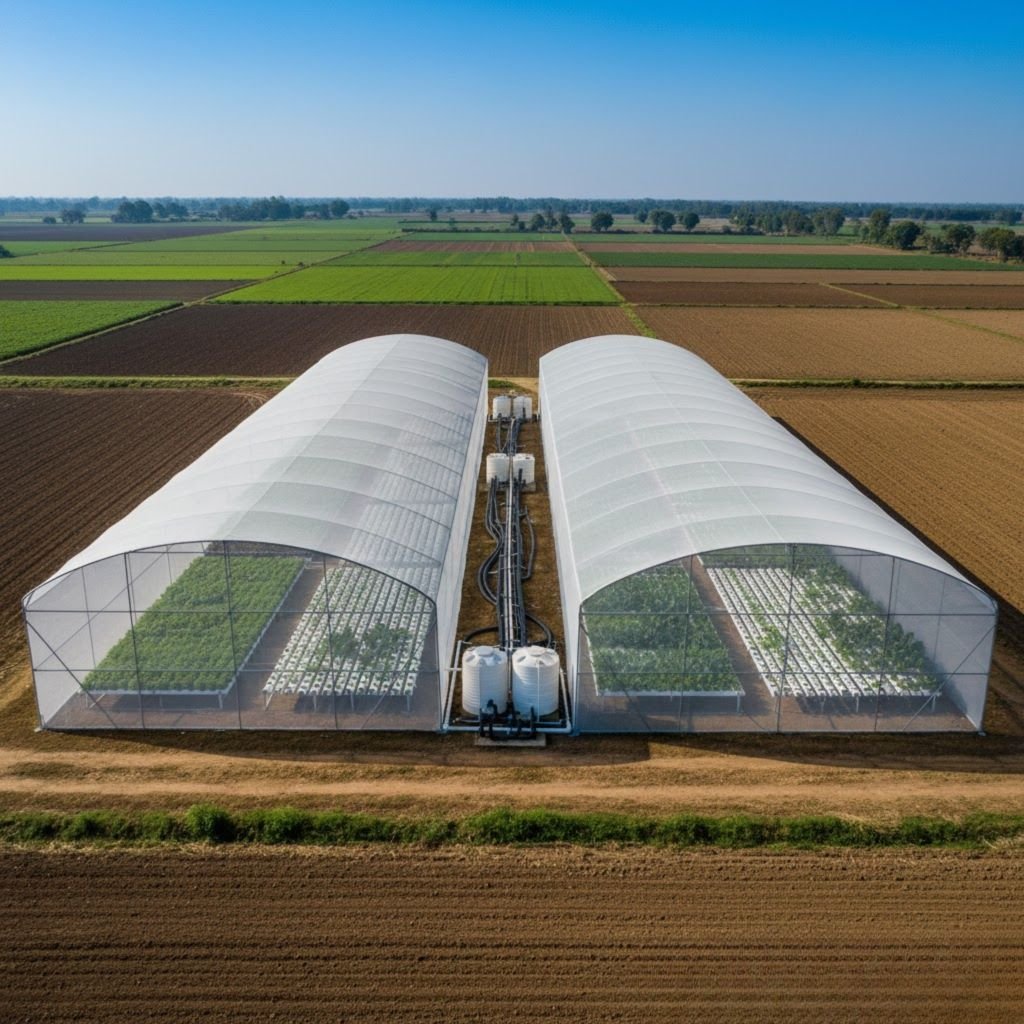
Flat Shape Net House – Technical & Practical Overview
Parameter Flat Roof Shade Net House Specification Why It Matters
Product Type Flat Roof Shade Net House (Pipe Structure) Simple, cost-effective structure for protected cultivation
Roof Type Flat Roof Suitable for low-height crops and easy installation
Structure Material Hot-dip galvanized GI pipe structure Ensures rust resistance and long service life
Available Sizes 500 m² / 1000 m² / 2000 m² / 4000 m² / 8000 m² / 12000 m² Flexible sizing for small and commercial farms
Grid Size 6 m × 4 m (NHB), 6 m × 6 m, 4 m × 4 m Maintains structural strength and subsidy compliance
Side Center / Height 4.0 m / 4.0 m, 5.0 m / 5.0 m, 5.8 m / 5.8 m Provides uniform height and stable crop environment
Hockey Height 2.0 m, 2.5 m, 3.0 m, 3.5 m Improves side strength and wind resistance
Side Covering Insect net (110 GSM), Mono × Mono with 140 GSM apron Protects crops from insects and external conditions
Top Covering Mono × Mono shade net (100–125 GSM) Controls sunlight intensity and heat
Second Layer Inside sliding net cover (optional) Additional protection during extreme weather
Trellising System 5 mm & 4 mm rope wire with 3 mm plastic wire Supports climbing crops and improves yield
Irrigation System Inline drip, fogging or sprinkler with filters Efficient water and nutrient management

Dome shape net house structures are a premium solution for protected cultivation and commercial net house farming in India, designed to offer higher structural strength, better airflow, and superior resistance to wind and extreme weather. Built with a curved GI pipe framework and UV-stabilized shade nets, dome shape net houses allow natural heat dissipation, maintain a stable microclimate, and improve overall crop performance. These structures are widely used for high-value crops, large-scale farming, and export-oriented cultivation, especially in windy and coastal regions.

Key Benefits of Dome Shape Net House

  • High-strength dome shape net house structure with excellent wind resistance
  •  Better airflow and natural temperature control for healthy crop growth
  •  Ideal for commercial net house farming and high-value crops
  •  Reduced risk of damage in high-wind and extreme climate zones
  •  Suitable for coastal, windy, and challenging agro-climatic regions
Dome Shape Net House – Technical & Practical Overview
Parameter Dome Shape Net House Specification Why It Matters
Structure Material Hot-dip galvanized GI steel pipes Prevents rusting and ensures long-term durability
Column Pipe Size 60 mm OD × 2.0 mm thickness Provides strong vertical load-bearing capacity
Arch Pipe Size 48 mm OD × 2.0 mm thickness Maintains dome shape and improves wind resistance
Intermediate Column 60 mm OD × 2.0 mm thickness Enhances overall structural stability
Hockey Pipe Size 60 mm OD × 2.0 mm thickness Strengthens side structure against wind pressure
Top Vent Type Dome type (round ventilation system) Improves air circulation and temperature control
Available Sizes 500 m² / 1000 m² / 2000 m² / 4000 m² / 8000 m² / 12000 m² Suitable for small to large-scale farming
Grid Size 6 m × 4 m (NHB), 6 m × 6 m, 4 m × 4 m Ensures strength and subsidy compliance
Side Center / Height 4.0 m / 5.5 m, 4.5 m / 6.0 m Allows better ventilation and crop growth
Side Covering 110 GSM insect net, apron sheet, Mono × Mono Protects crops from pests and harsh weather
Top Covering 200 Micron UV-stabilized polyfilm Controls sunlight and internal temperature
Subsidy Eligibility NHB / NHM compliant (approved design) Reduces overall project investment

Customized net house structures are designed based on specific crop requirements, land size, and local climatic conditions to deliver maximum flexibility and performance in commercial net house farming. These structures are engineered considering factors such as wind zone, height, ventilation, and future expansion, ensuring better microclimate control, healthier crops, and efficient use of investment with long-term durability and subsidy compliance.

Key Benefits of Customized Net House

  • Designed based on specific crop, land size, and local climate conditions
  • Flexible structure height, bay size, and ventilation configuration
  • Optimized for high-value crops and specialized farming requirements
  • Better control over temperature, light, and airflow
  • Allows future expansion or modification as farming needs grow
  • Suitable for subsidy-based and commercial farming projects
  • Ensures higher efficiency and long-term profitability
Customized Net House – Technical & Practical Overview
Parameter Custom Net House Specification Why It Matters
Product Type Custom Designed Net House (As per Site & Crop) Allows complete flexibility based on farmer requirements
Structure Design Customized (Dome / Flat / Hybrid) Optimized for land shape, climate, and crop type
Structure Material Hot-dip galvanized GI pipes (custom thickness) Ensures durability, strength, and long life
Pipe Size Options 48 mm / 60 mm / 76 mm OD (as required) Customized load-bearing capacity
Grid Size 4 m × 4 m, 6 m × 4 m, 6 m × 6 m (custom) Balances strength, cost, and subsidy norms
Height Configuration Customized side & center height Improves ventilation and crop performance
Side Covering Insect net (110–140 GSM), Mono × Mono Crop protection from pests & weather
Top Covering Polyfilm / Shade net (custom GSM & micron) Controls sunlight, heat, and humidity
Ventilation Type Top vent / Side vent / Natural ventilation Maintains ideal microclimate
Trellising System Customized rope & wire layout Supports crop growth and higher yield
Irrigation System Drip / Fogging / Sprinkler (as required) Efficient water and nutrient management
Wind Load Design Designed as per local wind conditions Ensures safety and long-term stability
Recommended Crops Vegetables, flowers, fruits, nursery, herbs Suitable for diversified farming needs
Subsidy Eligibility NHB / NHM compliant (design dependent) Helps reduce overall project cost
0
+
Years in Net House Installation
0
+
Successful Net House Projects
0
+
Crop-Specific Net House Designs
0
+
States Served Across      India

Net House Farming Cost per Acre in India

The cost of net house farming per acre in India varies depending on the type of structure selected, material specifications, and site conditions. In 2026, a standard net house project typically requires an investment of ₹30–45 lakh per acre before subsidy, with costs differing for flat roof, dome-shaped, and rain-protected net house structures based on their design strength and weather resistance.

Major cost components include a high-strength GI pipe structure, UV-stabilized shade nets, anti-insect nets, foundation and anchoring systems, and skilled installation labor. Additional factors such as wind zone classification, soil condition, crop type, irrigation planning, and local climatic conditions also influence the final project cost. A detailed site-specific assessment ensures accurate costing.

Project Particulars Structure & Material Specification Rate per Sq. Meter (₹) Total Cost (₹)
Single Layer Flat Roof Net House GI Structure (250 GSM) + 50% White Shade Net + Trellising + Installation ₹360 – ₹380 ₹14 – ₹15 Lakhs
Double Layer Net House (White Shade Net) GI Structure (250–275 GSM) + Secondary 50% White Shade Net + Trellising + Installation ₹390 – ₹420 ₹15.5 – ₹17 Lakhs
Double Layer Net House (Aluminet) GI Structure (275–300 GSM) + Aluminet 50% Secondary Layer + Trellising + Installation ₹500 – ₹540 ₹20 – ₹22 Lakhs
Dome Shape / Pipe Purlin Net House Heavy GI Pipe Structure (300 GSM) + Double Layer Shade Net + High Wind Resistance Design ₹750 – ₹820 ₹30 – ₹33 Lakhs
Government Subsidy (NHB / NHM) As per benchmark cost – subject to eligibility ₹450 – ₹500 ₹14 – ₹16 Lakhs
Total Farmer Investment After Subsidy ₹18 – ₹25 Lakhs

*Prices are indicative, inclusive of GST. Final cost depends on site conditions, wind zone, and state subsidy norms.

10

YEARS OF
EXPERIENCE
Materials & Technical Specifications Used in Net House Structures

Net house structures are built using carefully selected materials to ensure durability, crop protection, and long-term performance under Indian climatic conditions. High-quality materials not only improve structural strength and crop safety but also play a crucial role in wind resistance, maintenance cost, and eligibility for government subsidy schemes. The following are the key materials and technical specifications used in commercial net house farming projects.

GI Pipe Structure (Framework)

The main framework is constructed using hot-dip galvanized GI pipes to provide strength, stability, resistance to corrosion for long-term use.

  • Material: Hot galvanized steel

  • Zinc Coating: 250–300 GSM

  • Function: Structural strength and load bearing

  • Service Life: 15–20 years with maintenance

Shade Net (Light & Heat Control)

Shade nets are used to regulate sunlight and temperature, creating a suitable growing environment for different crops inside the net house.

  • Material: UV-stabilized HDPE

  • Shade Factor: 35%, 50%, or 75%

  • Purpose: Light diffusion and heat reduction

  • Benefit: Improved crop growth and quality

Insect Net (Pest Protection)

Insect nets prevent pest entry while allowing sufficient airflow, helping reduce crop damage and chemical pesticide usage.

  • Material: UV-treated HDPE

  • Mesh Size: 40 or 50 mesh

  • Function: Pest exclusion and ventilation

  • Result: Healthier crops with lower losses

Foundation & Anchoring System

A properly designed foundation ensures structural safety and resistance against wind pressure and ground movement.

  • Type: RCC footing & ground anchoring

  • Design Basis: Soil type and zone.

  • Purpose: Prevent uplift and instability

  • Outcome: Long-term structural safety

Fasteners & Accessories

High-quality fasteners and accessories are used to secure the structure and ensure correct alignment and load distribution.

  • Components: Clamps, bolts, nuts, profiles

  • Material: Galvanized steel

  • Function: Secure fixing of structure and nets

  • Advantage: Reduced wear and loosening

Ventilation & Structural Design

Ventilation design plays a key role in maintaining temperature balance and air circulation inside the net house.

  • Design Elements: Height, bay spacing, roof shape

  • Ventilation Type: Natural side and top ventilation

  • Purpose: Heat dissipation and airflow

  • Impact: Better plant health and yield

High-Profit Crops for Net House Farming in India

Net house farming enables growers to cultivate high-value crops with better yield consistency, superior quality, and reduced crop loss compared to open-field farming. By controlling temperature, light, and pest entry, net houses allow farmers to grow premium vegetables, flowers, and nursery crops that offer higher market prices and stable demand throughout the year. Crop selection plays a critical role in determining profitability and return on investment in commercial net house projects. Proper crop planning helps achieve faster break-even and stable long-term income.

Vegetable Crops : Net houses are ideal for vegetables such as colored capsicum, English cucumber, cherry tomato, hybrid tomato, lettuce, spinach, and leafy greens, offering higher yield, better quality, and consistent market pricing.

Flower Crops: Flower crops like gerbera, rose, and carnation perform well under net house conditions due to controlled temperature and protection, resulting in uniform growth and premium-grade flowers.


Why These Crops Are Profitable

  • Better control over temperature and light helps maintain an optimal growing environment, resulting in healthier plants and consistent crop performance throughout the year.
  • Reduced pest and disease incidence due to physical barriers lowers crop loss and minimizes dependency on chemical pesticides.
  • Higher yield per unit area is achieved through controlled conditions, efficient spacing, and improved plant growth compared to open-field farming.
  • Improved crop quality and uniformity leads to better grading, higher market acceptance, and premium pricing.
  • Ability to target off-season and premium markets allows farmers to sell produce when supply is low and prices are higher.


Net house farming in India enables higher crop yields, improved quality, and stable income through protected cultivation by creating a controlled growing environment that reduces climate risk, pest damage, and crop loss while supporting consistent, year-round production.

Frequently Asked Questions (FAQs) for the 3-Day Urban Hydroponics Farming Course

Yes, net house farming is better suited for commercial agriculture as it offers controlled growing conditions, reduced pest damage, and consistent crop quality, resulting in more predictable yields and stable income compared to open-field farming.

Wind zone and climate directly impact net house cost because higher wind speeds and extreme weather require stronger GI structures, deeper foundations, and reinforced design, increasing overall project investment but improving long-term safety and durability.

The best return on investment depends on location and crop choice—flat roof net houses provide faster ROI in low-wind regions, while dome shape or customized net houses offer better long-term returns in high-wind or challenging climates.

Profitability is reduced by poor crop selection, under-designed structures, ignoring wind load calculations, lack of market planning, and using substandard materials to reduce initial cost.

A customized net house structure is recommended when land size, crop requirements, wind conditions, or future expansion plans differ from standard designs, ensuring better performance and long-term profitability.

Proper net house height improves air circulation, temperature stability, and light distribution, which directly enhances plant health, reduces heat stress, and improves yield consistency.

Crops such as capsicum, cucumber, cherry tomato, leafy vegetables, and nursery seedlings can be cultivated in planned cycles to generate year-round income under net house conditions.

Yes, net house farming can be profitable through local wholesale markets, retail chains, and direct buyers when crops are selected based on regional demand and pricing trends.

UV-stabilized shade nets and insect nets typically require replacement every 3–5 years depending on material quality, sunlight exposure, and maintenance practices.

Contact Us